







The Real Cost to Run an Air Conditioner (2026 Update)
The weather is hot and you're almost to the point where you don't care what it costs — but let's take a look anyway. Understanding the cost to run an air conditioner helps you budget for summer and spot when your system is costing you more than it should.
The Cost Equation
Although costs vary, you can generally predict the cost to run an air conditioner with a little math.
Disclaimer: the following is based on average Columbus, Ohio electricity costs. If you live in a different area, adjust the numbers to match your own rate.
Let's assume you live here in Columbus and it's really hot out, so your air conditioner runs about 10 hours a day.
As of 2026, the average all-in cost of electricity in Columbus, Ohio is about 15.6 cents per kilowatt-hour — and thanks to rising regional energy demand, that number has climbed noticeably over the past couple of years. In fact, the average Columbus home saw its monthly electric bill jump by roughly $25 in a single recent summer. That makes understanding your air conditioner's share of the bill more useful than ever.
Important Equipment Numbers You'll Need
Air conditioners are rated by total amperage. Here's a basic breakdown:
- 2 Ton AC = 15 amps
- 3 Ton AC = 18 amps
- 4 Ton AC = 21 amps
Most central air conditioners also run on a standard 240 volts. Now let's calculate total wattage, using a standard 3-ton AC as our example:
18 amps × 240 volts = 4,320 watts
Divide by 1,000 to get kilowatts: 4.32 kilowatts per hour.
Calculating With Your Electricity Costs
Now let's factor in the electricity rate:
4.32 kW × 15.6 cents = about 67 cents per hour to run a standard 3-ton AC.
That may not sound like much, but it adds up fast:
- 67 cents × 10 hours = about $6.70 per day
- $6.70 × 30 days = about $200 per month to run your air conditioner
Add that to the rest of your household electricity use and your electric bill can climb quickly during an Ohio summer.
Variables to Consider
If your rate isn't 15.6 cents per kWh, just swap in your own number to estimate your cost to run an air conditioner. A few things move this number up or down:
- Efficiency. A modern high-efficiency air conditioner uses far less power for the same cooling. The U.S. Department of Energy estimates that upgrading to a high-efficiency unit, paired with regular maintenance, can cut the energy your AC uses by 20–50%.
- Maintenance. A dirty coil or low refrigerant forces your system to run longer and harder. Routine HVAC maintenance keeps it running efficiently.
- Age. Older units are far less efficient. Some studies estimate that an older, non-efficient cooling system can account for 60–70% of your summer electric bill. If yours is aging, it may be time to look at a replacement.
Do Air Conditioners Use a Lot of Electricity?
They can. The U.S. Department of Energy estimates the typical American family spends about half of its annual energy bill on heating and cooling. If you keep noticing high bills and your AC running nonstop, it may be a sign your system is oversized, undersized, low on refrigerant, or simply worn out.
Is It Cheaper to Run the AC All the Time?
It might seem like turning the AC off while you're away saves money, but it usually doesn't work out that way. Air conditioners run most efficiently at a steady pace. If you shut yours off for eight hours during the hottest part of the day, it has to work overtime to catch up when you get home — and that catch-up burns extra energy.
The smarter move is a programmable or smart thermostat. Set it a few degrees warmer while you're out, and your home stays close enough to comfortable that the system never has to strain to recover.
Keep Your Cost to Run an Air Conditioner Low
The best way to control the cost to run an air conditioner is a well-maintained, right-sized, efficient system. If your bills keep creeping up, we can help you figure out why. Contact Sears Heating & Cooling for a free estimate — we've kept Columbus homes comfortable and efficient since 1950.
FAQs about AC Costs
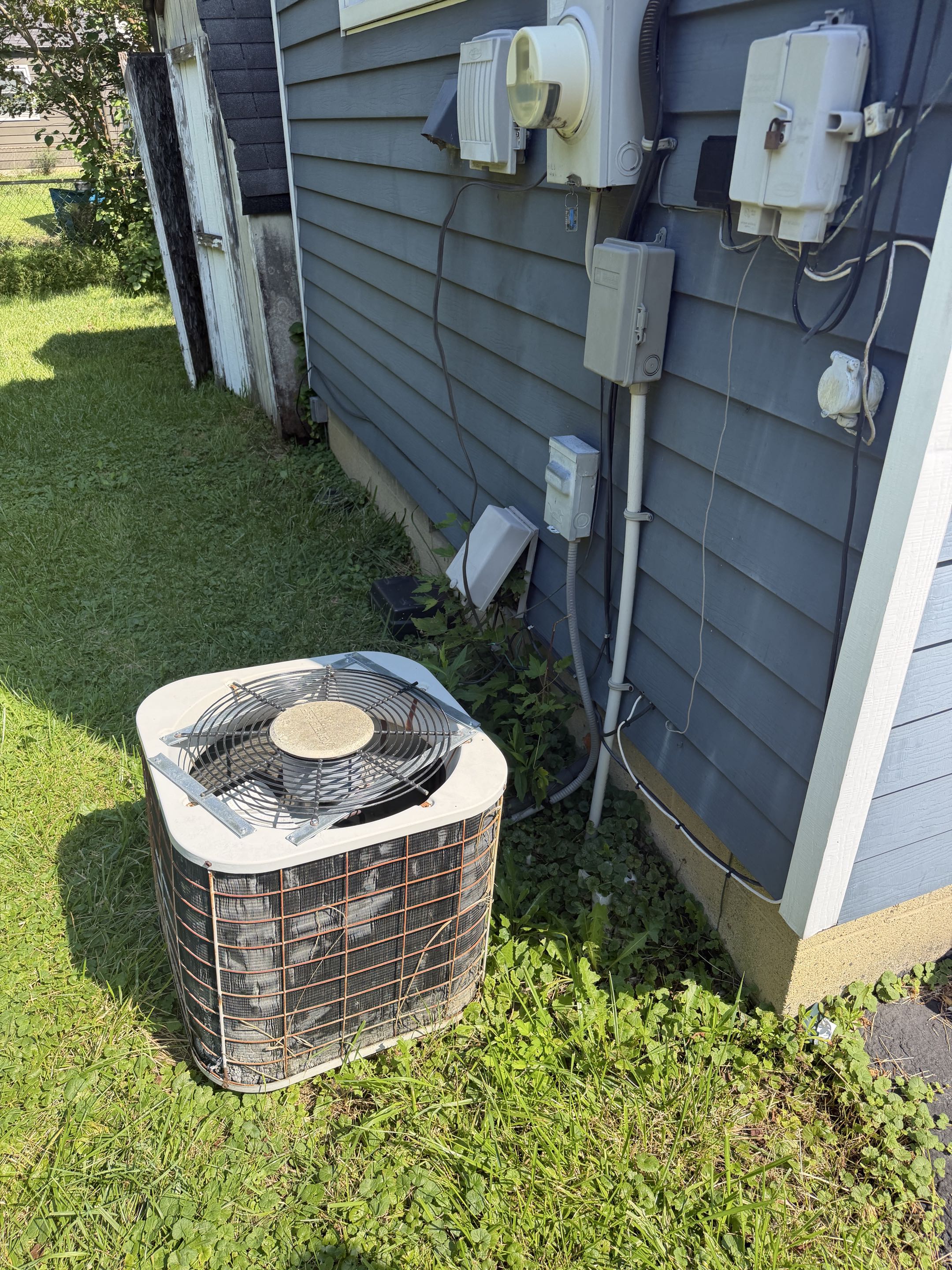
The compressor in the outdoor unit is the biggest energy draw by far — it's what actually pulls heat out of your home. That's why a struggling or oversized compressor, or one working against a dirty coil, can send your running cost climbing even when the rest of the system looks fine.
Not necessarily — but the wrong-sized one does. An oversized AC short-cycles (switches on and off rapidly), which wastes energy and wears out parts, while an undersized unit runs nonstop trying to keep up. A proper load calculation before installation is what keeps your running cost in check.
Yes, when used well. A programmable or smart thermostat that eases the temperature a few degrees while you're away can trim cooling costs without the system having to strain to catch up later. It's one of the cheapest efficiency upgrades available.
Once a year, ideally in spring before cooling season. A tune-up keeps the coil clean, refrigerant at spec, and airflow strong — all of which directly affect how much electricity your system burns.